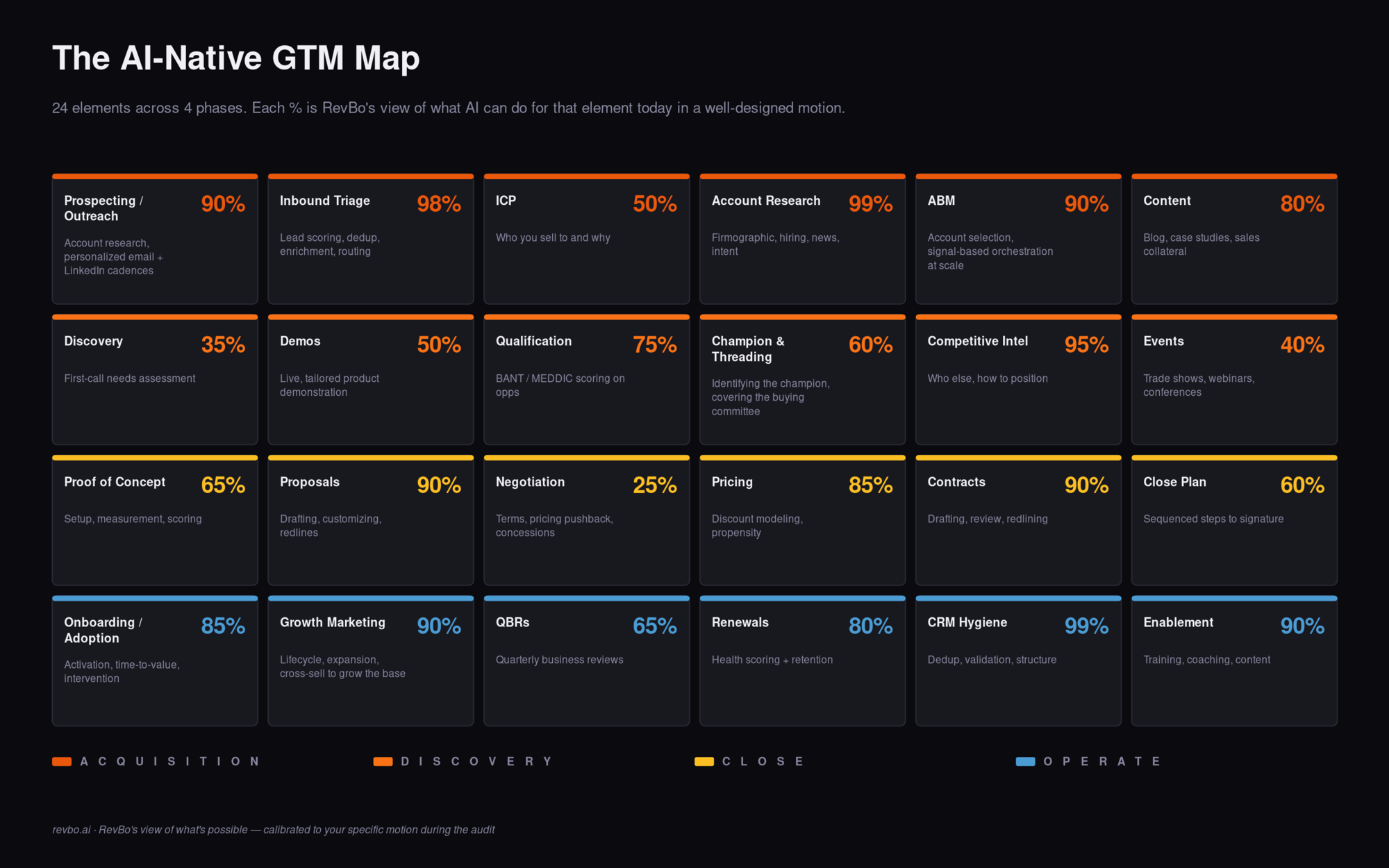
The map
Most GTM teams I talk to are using AI somewhere. The problem is they can't tell you where it fits in the motion. A rep bought Clay. Marketing got Apollo enrichment. Someone signed a contract for an AI SDR. Six months in, the tool list is long — but there's no system.
The AI-Native GTM Map is what I draw on a whiteboard when I sit down with a leadership team. Four phases across the revenue lifecycle — Acquisition, Discovery, Close, Operate — with six elements in each. Twenty-four total. Every revenue motion in B2B SaaS is some combination of these.
The point of naming the pieces is so you can score them. For each element I put a number on it: RevBo's view of what's possible with AI today, given good foundations underneath. Not aspirational. Not theoretical. What I've actually seen work, or believe is one design cycle away.
Over the next four posts I'm walking through all 24, one phase at a time. Today: Acquisition.
Two flavors of AI — assistive vs. autonomous
Before going element by element, this distinction matters more than the percentage on the slide.
Assistive — AI does the heavy lift, a human reviews and ships. Drafting, summarizing, suggesting, scoring. The human is in the loop every cycle.
Autonomous — AI runs the loop end-to-end. The human only shows up for exceptions. The system detects the signal, does the work, and delivers the output without anyone clicking a button.
Most teams in 2026 are doing assistive AI everywhere and autonomous AI nowhere. The unlock — and the gap that's about to widen between AI-native teams and everyone else — is the autonomous side. That's where capacity actually multiplies.
Watch the tag next to each element header below. Anything marked Autonomous is a system that runs on its own once you've set it up right.
The six elements of Acquisition
1. ICP Human-led 50%
The strategic input. AI can analyze your closed-won data, cluster accounts, surface patterns, pressure-test assumptions. It cannot tell you what bet you want to make next quarter, what segment your board wants you in, or which adjacent market is worth a wedge. That's a leadership call. If your ICP is a vibe — "anyone with 50+ employees who's growing" — no AI is going to save you. Get the ICP right yourself; let AI execute against it.
If you're not sure where your ICP sits today, the AI-Native GTM Scorecard grades it across eight dimensions in 90 seconds. It's the cheapest way to find out whether your ICP is a real definition or a story you tell investors.
2. Prospecting / Outreach Autonomous for the long tail · Mixed for the top 90%
Researching accounts, drafting first-touch sequences, multi-channel orchestration, follow-up cadences, reply handling — AI does almost all of it well now. The 10% you don't automate: the named senior-buyer plays where a human reach-out genuinely matters. Rep judgment picks the top ~5% of accounts to handle by hand. The other 95% runs through a machine that researches, drafts, sends, follows up, handles replies, and books the meeting on a rep's calendar without anyone clicking through.
3. Inbound Triage Fully Autonomous 98%
The easiest win on the board and the one most teams haven't touched. Every form fill, demo request, content download, and pricing-page visit gets enriched, scored, routed, and either auto-replied to or assigned in under a minute — with zero human touch on each event. The 2% is the edge case: a strategic logo where you want a human in the loop on first contact.
If your inbound MQLs take more than a couple hours to get a response, you're handing 30–40% of that pipeline to whoever replied first. Autonomous triage closes that gap completely.
4. Account Research Fully Autonomous 99%
The clearest call on the board. Triggered by a signal — meeting hits the calendar, account added to a list, intent spike, job change — the system pulls 10-Ks, news, tech stack signals, funding events, hiring patterns, vendor footprint, and synthesizes it into a one-pager the rep reads in two minutes before the call. No one had to ask for it. The 1% is anything that requires picking up a phone or talking to a former employee.
Reps who still spend 45 minutes a day "doing research" are doing it because nobody set this up for them.
5. ABM Autonomous on signal · Human on inputs 90%
Signal-based ABM is where AI has a real unfair advantage. Humans set the target list and the offer. After that the system runs autonomously — detecting buying signals across accounts, dynamically scoring engagement, sequencing ads + email + SDR touches against named accounts, adjusting in real time. The data flywheel is too big for any marketer to hold in their head, and the system doesn't sleep.
6. Content Human-led, AI does the lift 80%
Drafts, outlines, social posts, repurposing, SEO refresh, turning customer call transcripts into blog seeds, generating variants — AI is genuinely strong here. The 20% that stays human: original thesis, opinion, point of view. Anything that requires you to be wrong on the internet for a reason. AI-generated thought leadership is detectable and it's already commoditizing. The premium goes to people who write from the field.
The shape of the phase
Look at the map again. Five of the six elements are 80%+. ICP is 50%. That's not an accident.
The high-AI elements are operational — volume, enrichment, retrieval, routing, drafting. The one low-AI element is the strategic input. The shape of every phase will look similar: the inputs require judgment, the execution doesn't.
And of those five high-leverage elements, three can run fully autonomously (Inbound Triage, Account Research, signal-based ABM) and two are autonomous-with-exceptions (Prospecting/Outreach, ABM execution). That's where capacity actually multiplies — and where the gap between AI-native teams and everyone else is widening fastest.
The trap: when a team skips the ICP work and goes straight to "let's get the AI SDR running" — that's where you see the burn. You can't outpace a bad ICP with more volume. You just spend more, more efficiently, being wrong about who to sell to.
What's next in the series
Next up: Discovery — the phase where AI scores noticeably lower than most people assume, and where operators who know what they're doing pull ahead.

Where does your GTM motion actually sit on the map?
Take the 90-second AI-Native GTM Scorecard. You'll get a score on each of eight dimensions of your revenue engine, a peer benchmark by company stage, and three things to fix this quarter — including where AI is currently not earning its place in your motion.
Get your Scorecard →